It took many months to get an appointment, but I finally met with a vascular neurologist. He looked at my medical history, including the neuro-psych exams, and ordered numerous blood tests, heart monitoring, autonomic testing, another MRI with contrast, etc., to rule out other potential causes of my symptoms. He concluded that based on the cognitive testing, the MRIs, and other physical test data that I had early stage vascular dementia.
I told him that I had been having transient bouts of depression, but I was getting through them. He then said words to this effect: “Well, get used to it, because as your brain continues to die from this disease it will throw off various neuro-chemicals that will worsen the depression.” (I chuckled and told him he was a “good news kind a guy.”) Up until this point I had never used antidepressants, anxiety meds, etc. At some point after my diagnosis, my depression and my anxiety worsened and I started taking appropriate medication. I am glad I did.
The diagnosis of Alzheimer’s disease came about one year ago. After all other testing had been completed, I began to get more symptoms, including auditory hallucinations, etc. My doctor decided he would look further and in 2025 ordered a PET scan. After he and his colleagues at the University of Utah medical school viewed the scan, they all agreed that what I had was early stage Alzheimer’s. The scan also revealed that I had significant hypometabolism, that is, a reduction in my brain’s metabolic rate. The scan indicated that my brain processes had slowed down significantly, which is consistent with my experience over the last few years. Hypometabolism, I am told, is a major factor of Alzheimer’s disease.
At the same time I began an internal debate and struggle with myself about things like the following: “why try,” “ nothing else I can do, I have no other skills,” “it’s too hard,” “I am too tired,” “my brain feels like it is going to blow up when I think,” “I am too depressed,” “I am too anxious,” “I can’t retain much,” “I can’t connect dots in my head anymore,” “there is no cure for this,” etc. It was not a pleasant time for me. My life at that point could be best described by a line from the song Rainbow by Kasey Musgrave - “it’s hard to breathe when all you know is the struggle to stay above the waterline.” I had to keep taking multiple medications just so I could function, let alone think abstractly or beyond the moment right in front of me.
I started getting serious about photography a few years ago in between my diagnosis of dementia and Alzheimer’s. I believe this is a significant point to consider because I was well into my symptoms and cognitive changes when I began to get serious about photography. At some point I knew I was going to have to retire relatively soon even though I enjoyed my job and had planned on working, at least part time, for many years to come. My neurologist had recommended I retire a few years earlier because of my stress levels, which is seriously not good for my disease. He also told me I should have a physical exercise routine as well, and to keep trying to do new things with my brain and to socialize. (As a result of my work hours at that time, and other commitments, I had no hobbies.) He said if I did these things I might be able to at least slow down the progress of my disease.
It was at this point that I began to seriously consider wildlife and nature photography as something to do that could keep my brain functioning at some level, lessen my stress, and possibly help slow down the speed with which my disease was progressing. To be clear, I am not a professional photographer.
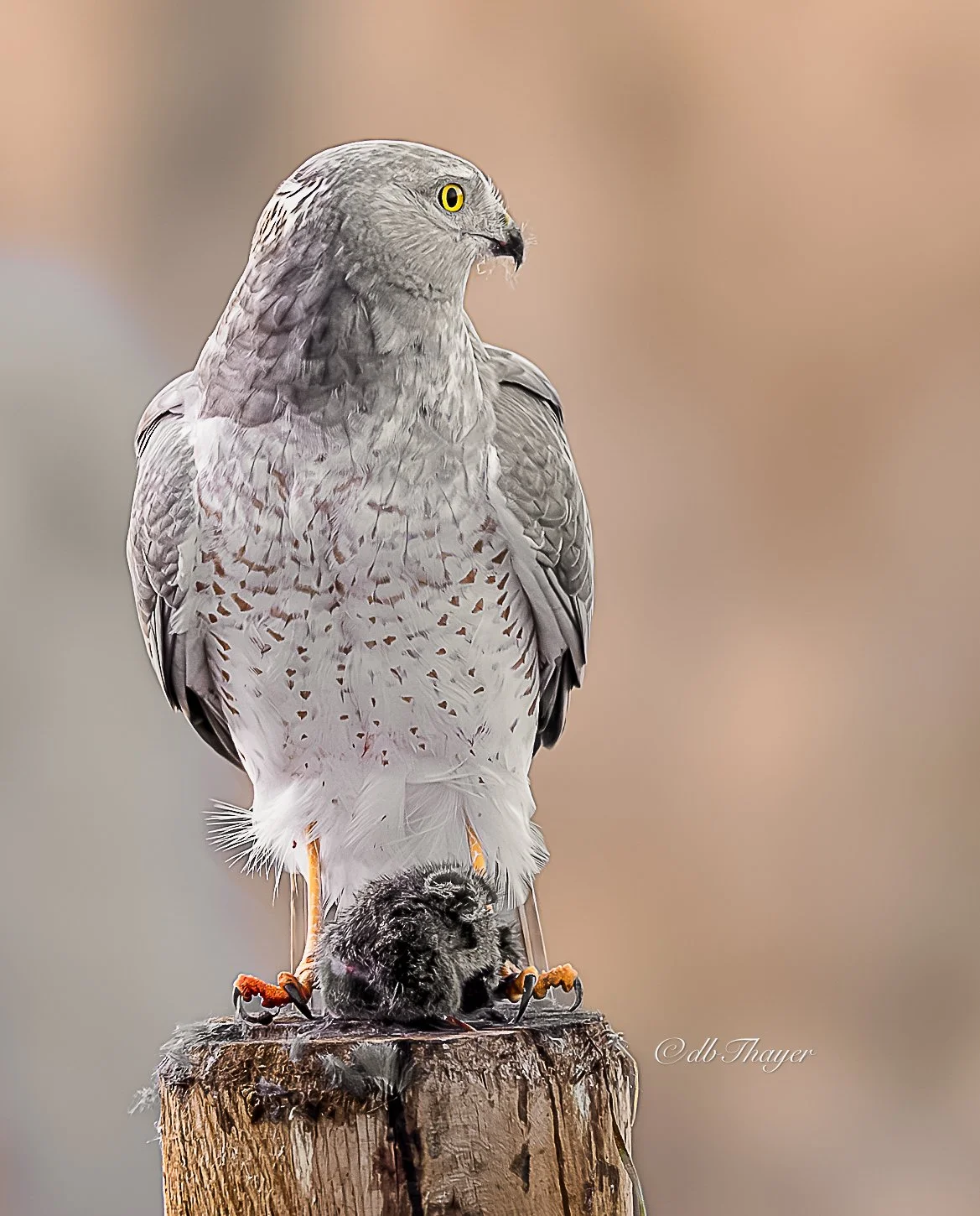
This bird is a male northern harrier hawk, sometimes called the “grey ghost” because of its color. I saw him sitting on a fence post as I slowly drove by a large field. He had apparently just caught his breakfast. If I was not willing to stop my car and turn around, I would never have gotten this shot. Sometimes we need to slow down and check to see if we are going in the right direction, even now. If not, we must be honest enough with ourselves to “turn around” and get to the right spot for us. This photo was taken in 2026 at Farmington Bay.